Product Owner & Lead Designerfor WizCouncil
An AI-training platform for UK professionals. I took a non-technical founder's vision from a domain name to live in ~3 months — two products and a marketing site under one brand — and the CEO now runs it without engineers.
- Role
- Product Owner & Lead Designer
- Team
- Solo lead + 2 engineers
- Tools
- Figma, Notion, Slack, Claude Code
- Scope
- Brand, marketing, learner app, admin CMS
Act 01
The brief
an AI-training vision, nothing built yet
The problem, the audiences, and what I owned.
1.1 Brief
Zero to live platform: every surface owned.
A non-technical founder had a clear vision for structured AI training, but no brand, product, admin tooling, or operating system.
I turned that early idea into a live platform spanning the marketing site, learner experience, and CEO-operated CMS.
1.2 At a glance
Shipped, at a glance
1.3 Problem
What made this hard.
AI learning gap
Professionals across 15+ industries knew they needed AI skills but did not know where to start. Existing options were too technical or too superficial, so the product had to land in the middle.
Two audiences
Corporate teams needed training that integrates AI into existing workflows. One platform had to serve individual learners and enterprise buyers without diluting either.
Founder-led operations
The product had to be operator-led from day one. Non-technical founders should not need engineers to ship a course or update the prompt library.
1.4 My role
The strategy, every screen, and the build plan.
Strategy
Set the product direction — including the build-vs-buy call that defined the whole scope.
Design
Designed every screen of the learner and admin products, and reviewed each build against the design source.
Team
Hired two engineers and ran delivery as a dialogue: I brought the execution plan — the user flows, what to build, in what order — and they brought the tech cost and build time of each element. Scope was negotiated there, not assumed.
Scoping
Translated a non-technical vision into honest estimates — what features cost to build, where payment compliance bites, and what an MVP could safely cut.
Act 02
The build
learner side · admin side · marketing site
I designed the learner product, the admin product, and the website that sells them — one brand across all of it. Every decision follows one thread: a non-technical founder had to be able to run it alone.
2.1 The first call
Build or buy?
I argued the boring option first
Before any custom build, I put Teachable and the other off-the-shelf LMS routes on the table — faster, cheaper, proven. If the business case for custom wasn't real, we had no business building one.
Why custom won
The founder's strategy genuinely needed it: an own-brand product for the UK market, room to scale into more AI courses, and a white-label play — letting education clients run their own courses on the platform later. No off-the-shelf LMS covered that.
References set the bar
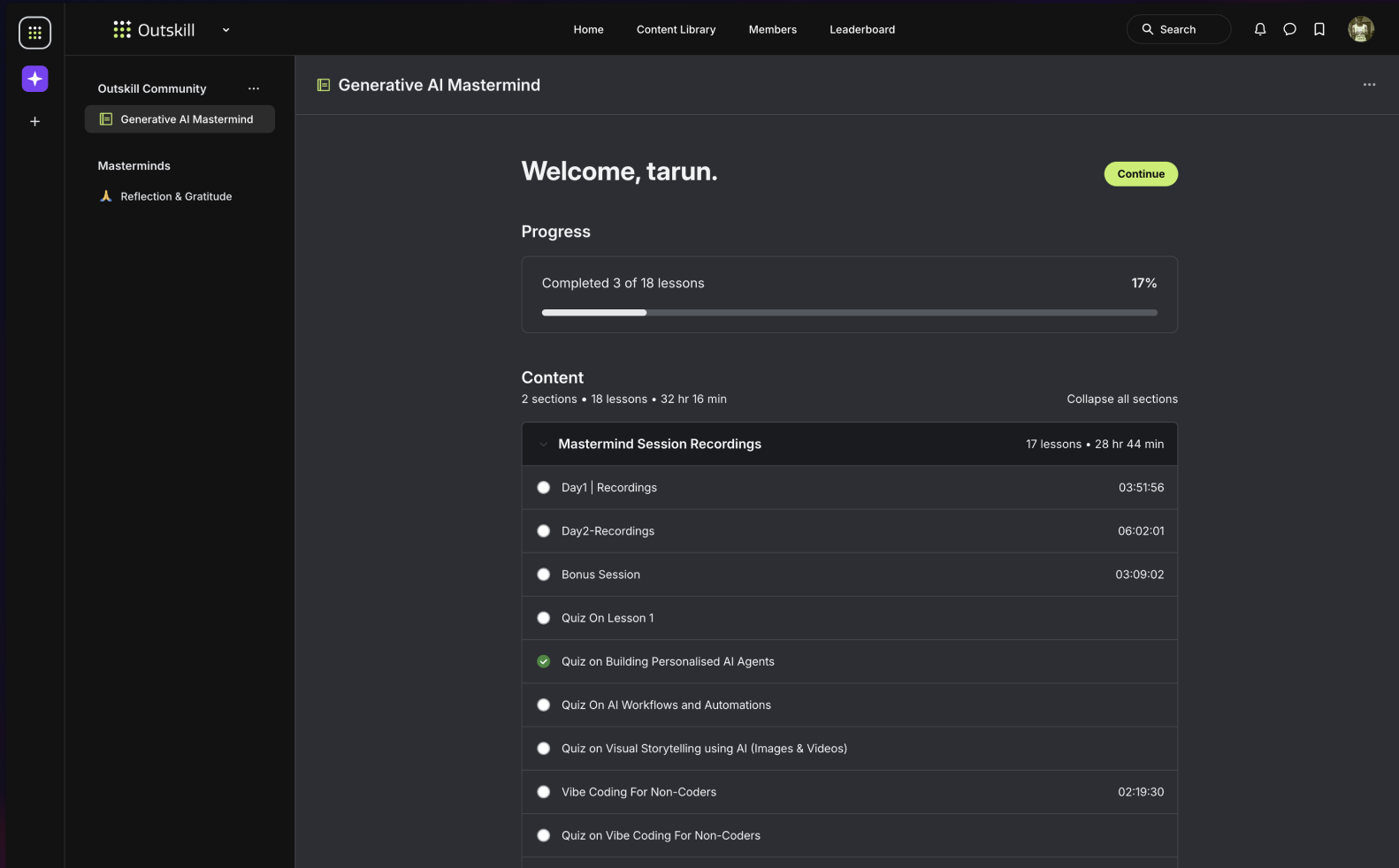
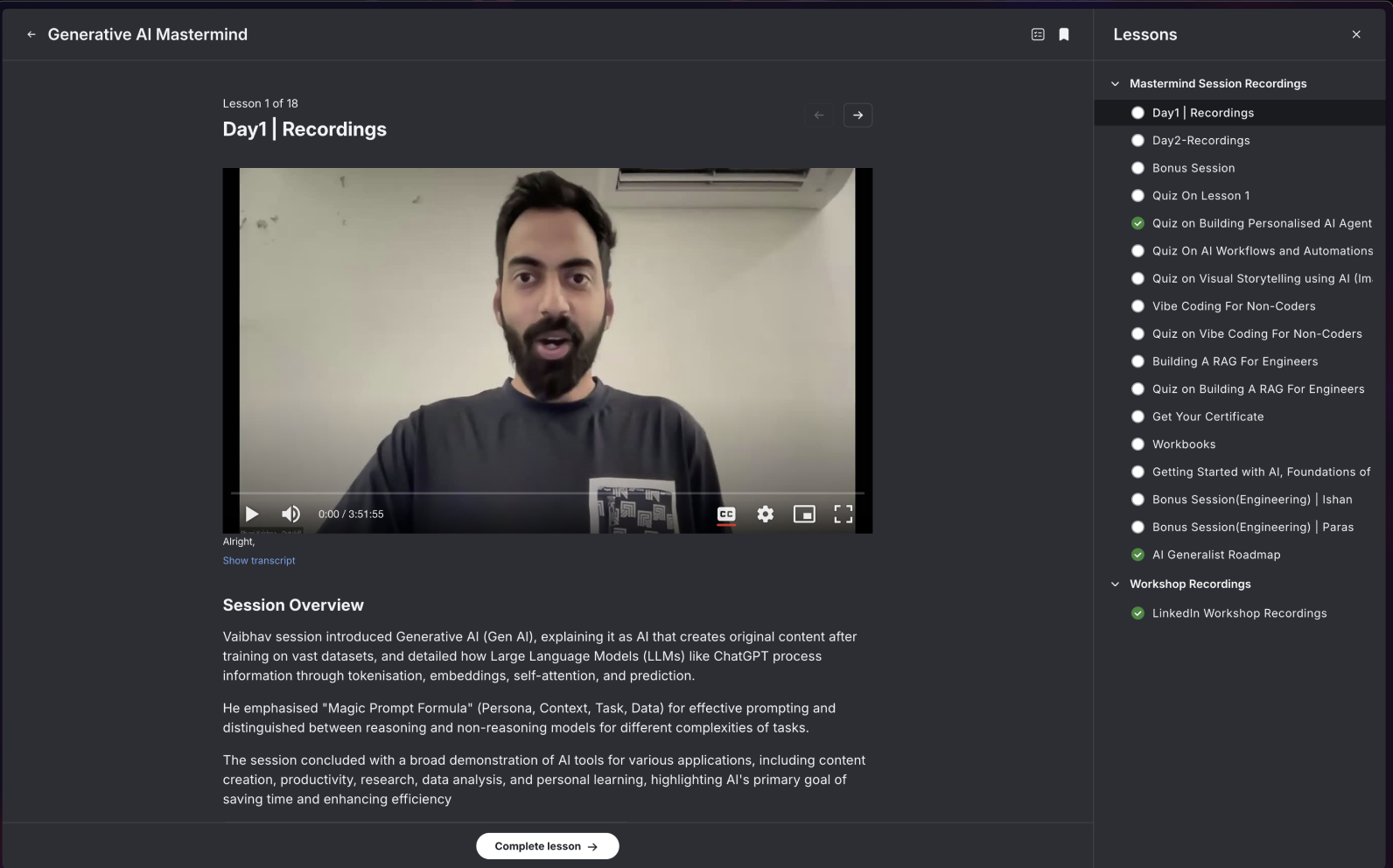
Outskill.io became the learner-experience benchmark and Coursera the player benchmark — chaptered video streaming, transcripts, quizzes. That definition of "good" is what told us exactly what the admin side had to be able to author.
2.2 The sprint
Three weeks to dev-ready
Wireframes before pixels
Early wireframes locked the flows with the founder before any visual design existed — cheap to argue about, cheap to throw away.
AI-speed drafting, hand-finished
I generated the MVP design fast with Figma Make, then polished it by hand. The speed bought extra founder-testing rounds instead of being spent on pixel production.
Cut to MVP, together
Every screen was tested with the founder; features had to earn their place or get cut. Quality held over three weeks because scope never sprawled.
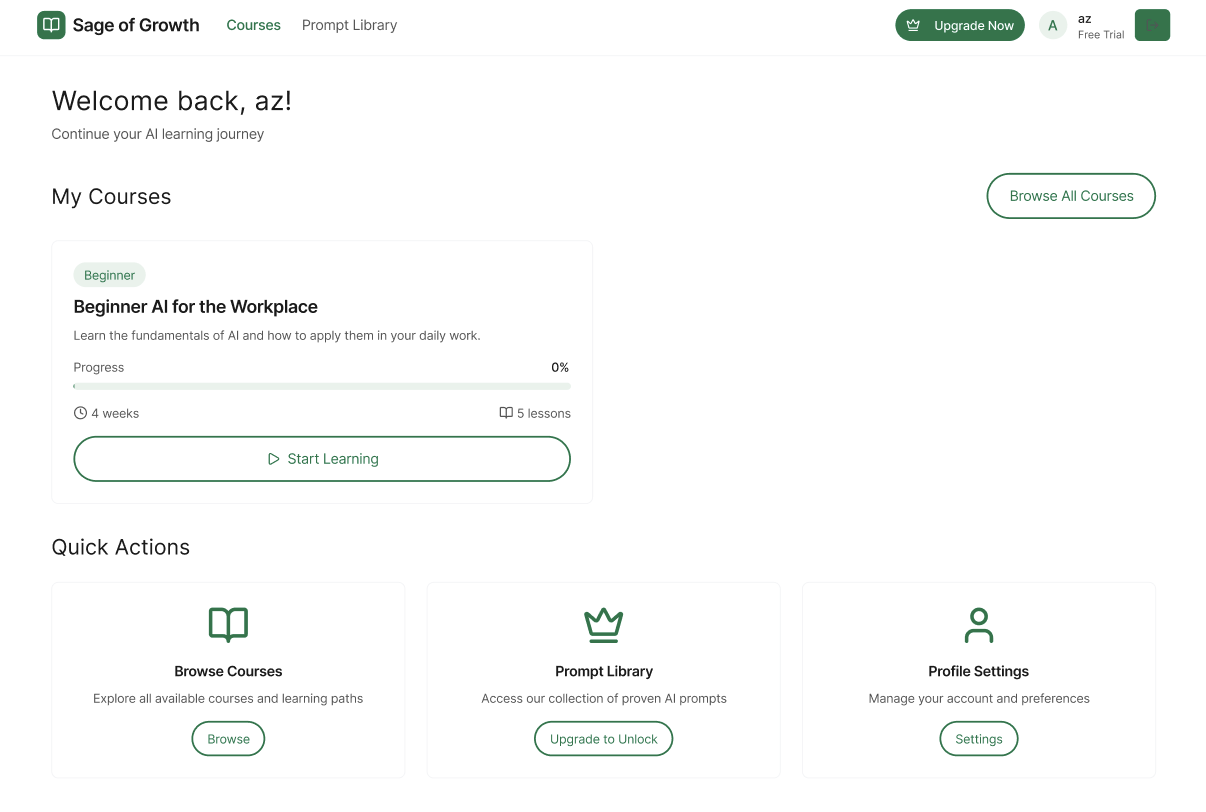
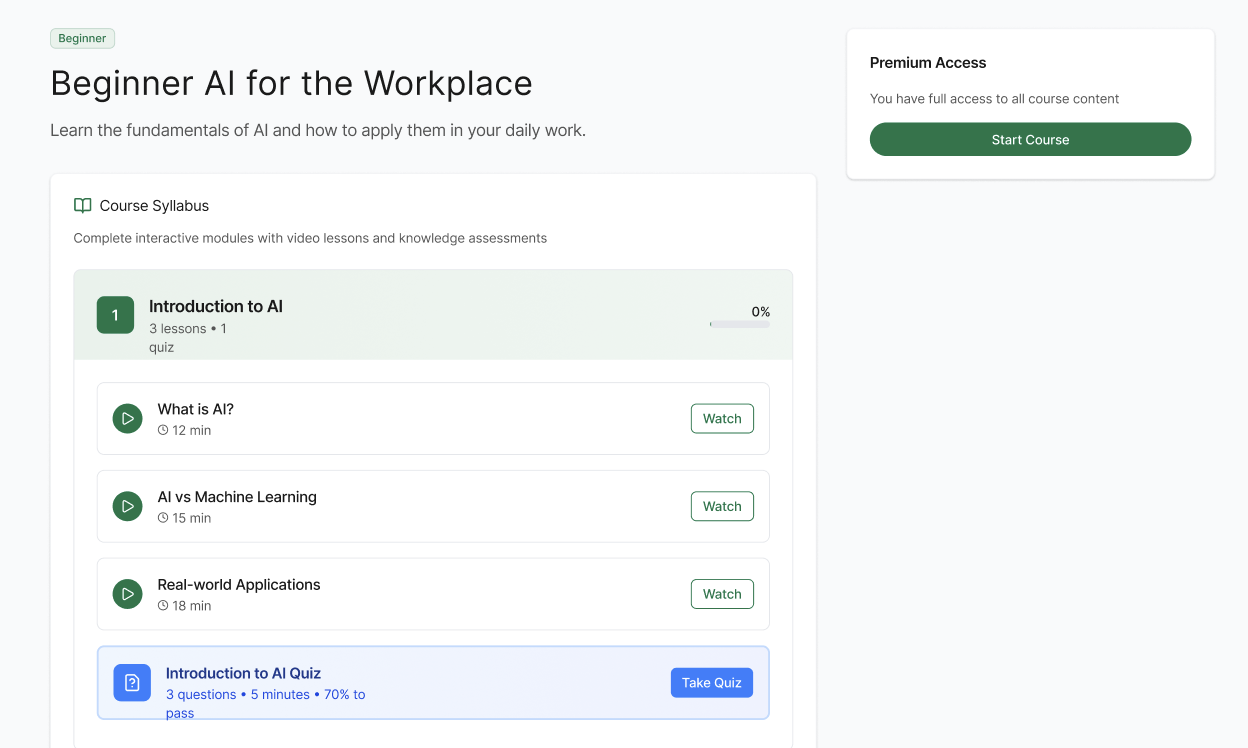
2.3 The learner side
Self-serve for individuals, CEO-led for corporate.
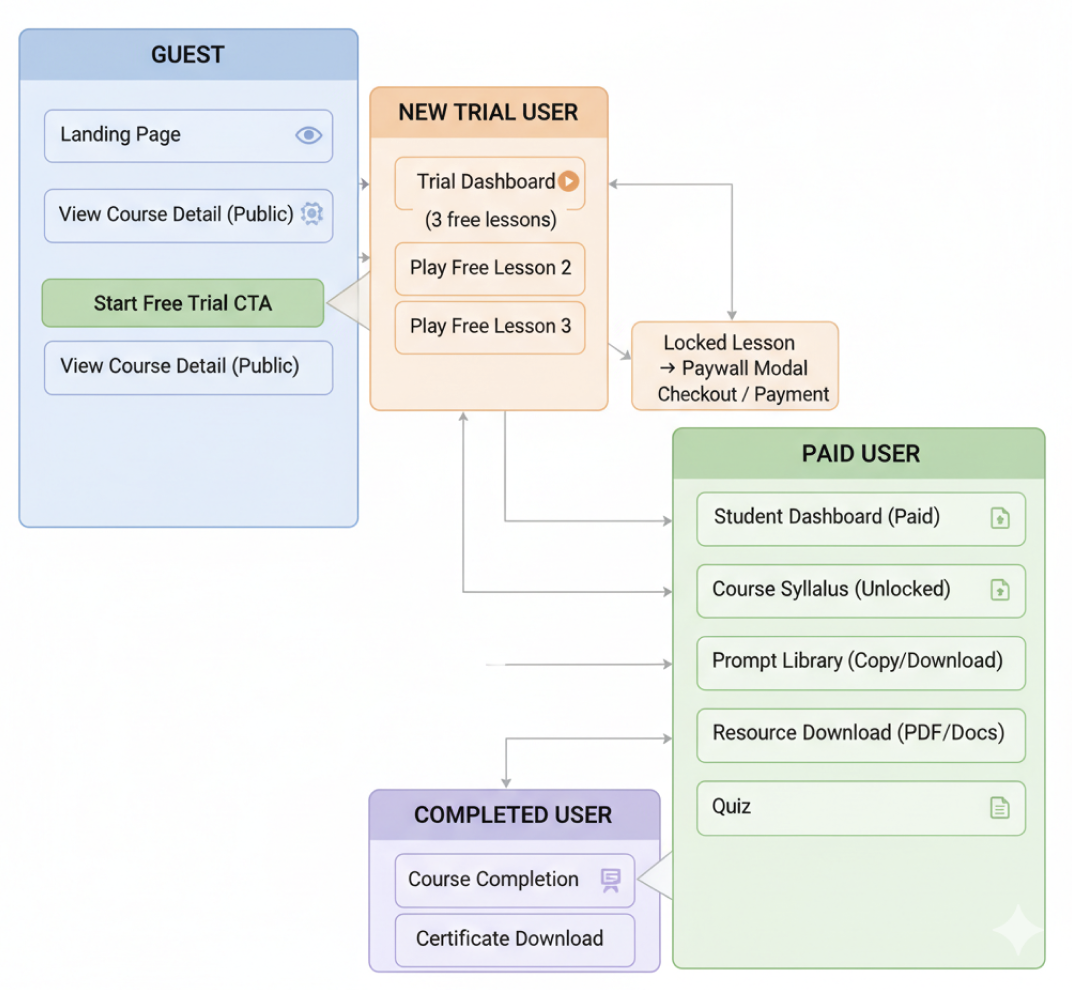
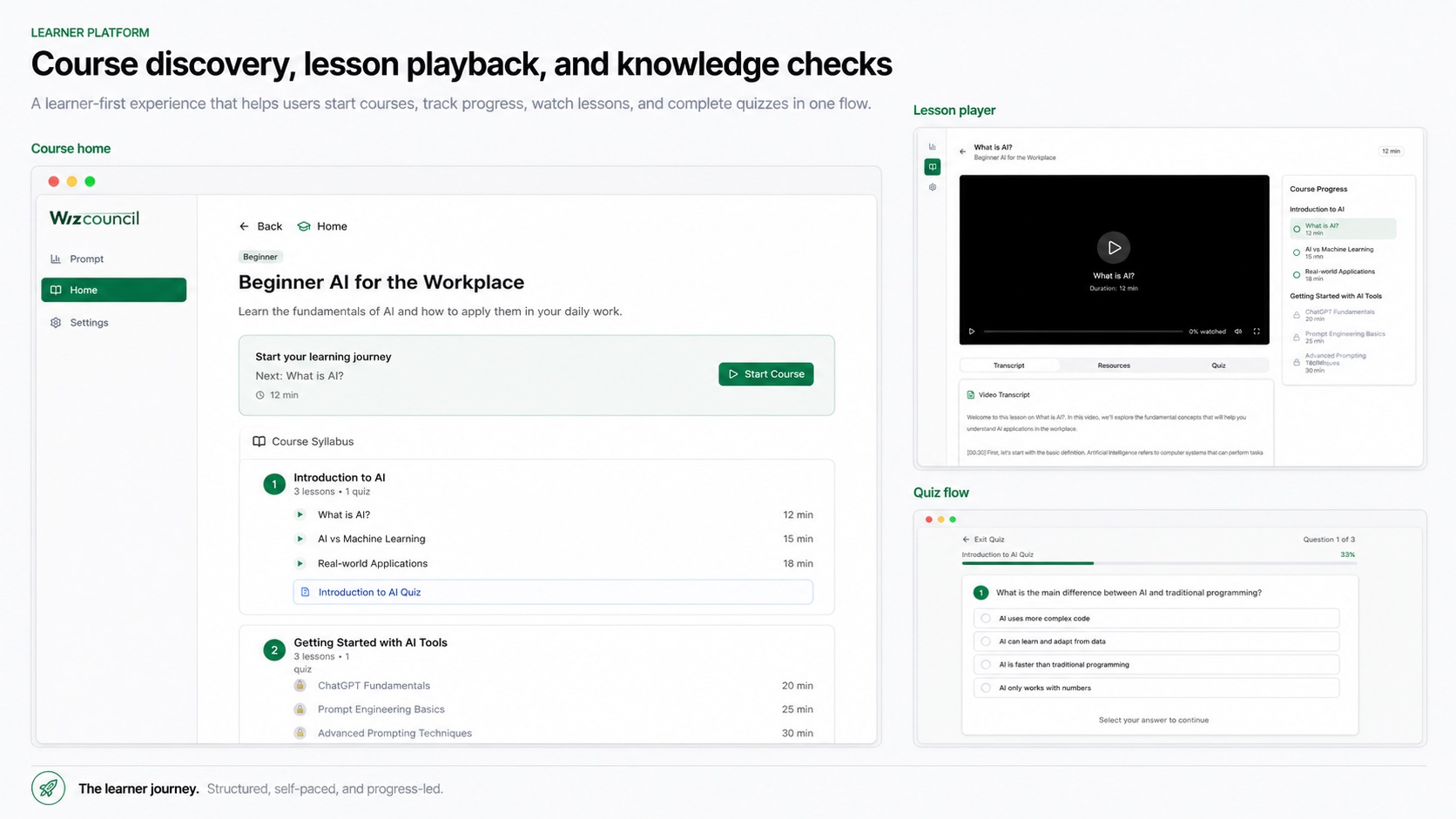
Individuals and corporate clients had different buying journeys, but a non-technical founder could not run two separate products. The solution was one learner product with two paths: self-serve for individuals and CEO-led for corporate. Same content engine, same learner area, compressed into three steps: Begin, Learn, Results.
- Begin: assessment and learner intent capture.
- Learn: tools, sessions, lesson playback, and knowledge checks.
- Results: workplace application and proof of progress.
2.4 Marketing site
Convert skeptics in one scroll.
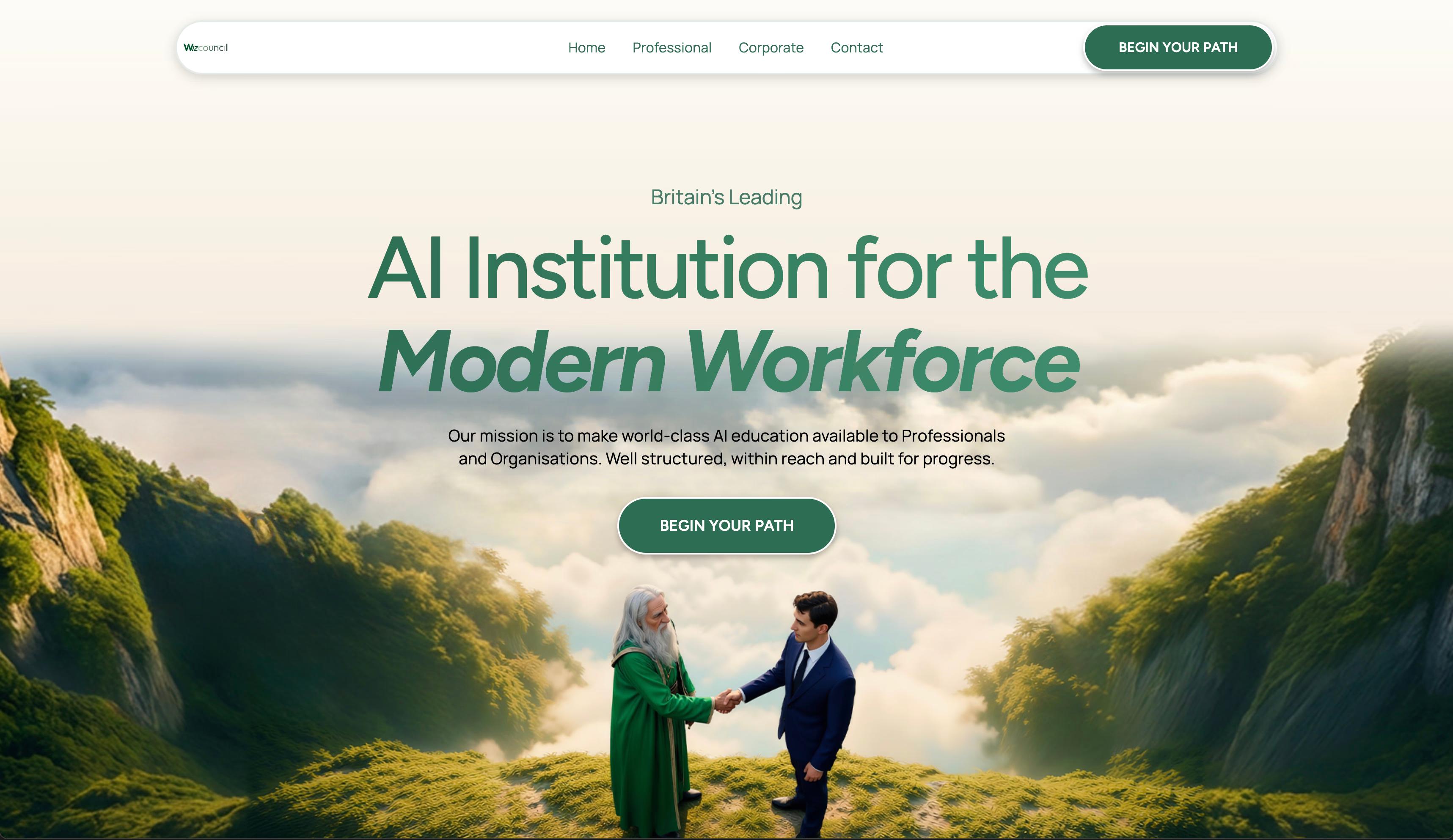
The positioning wasn't guessed. I worked with Mo, a UK teaching professional, to map gaps in the UK training market — at the time, very few structured AI courses were actually selling there — and to land the emotional frame: professionals weren't afraid of AI, they were afraid of being replaced by it. So the site sells empowerment, not replacement.
From there, the page had to convince professionals that structured training is worth paying for when free YouTube exists: the hero claims authority in one line with no hedging, the problem section mirrors the visitor's pain, testimonials add proof, and two conversion paths separate individuals from corporate clients.
2.5 The admin side
The admin side: run the platform without engineers.
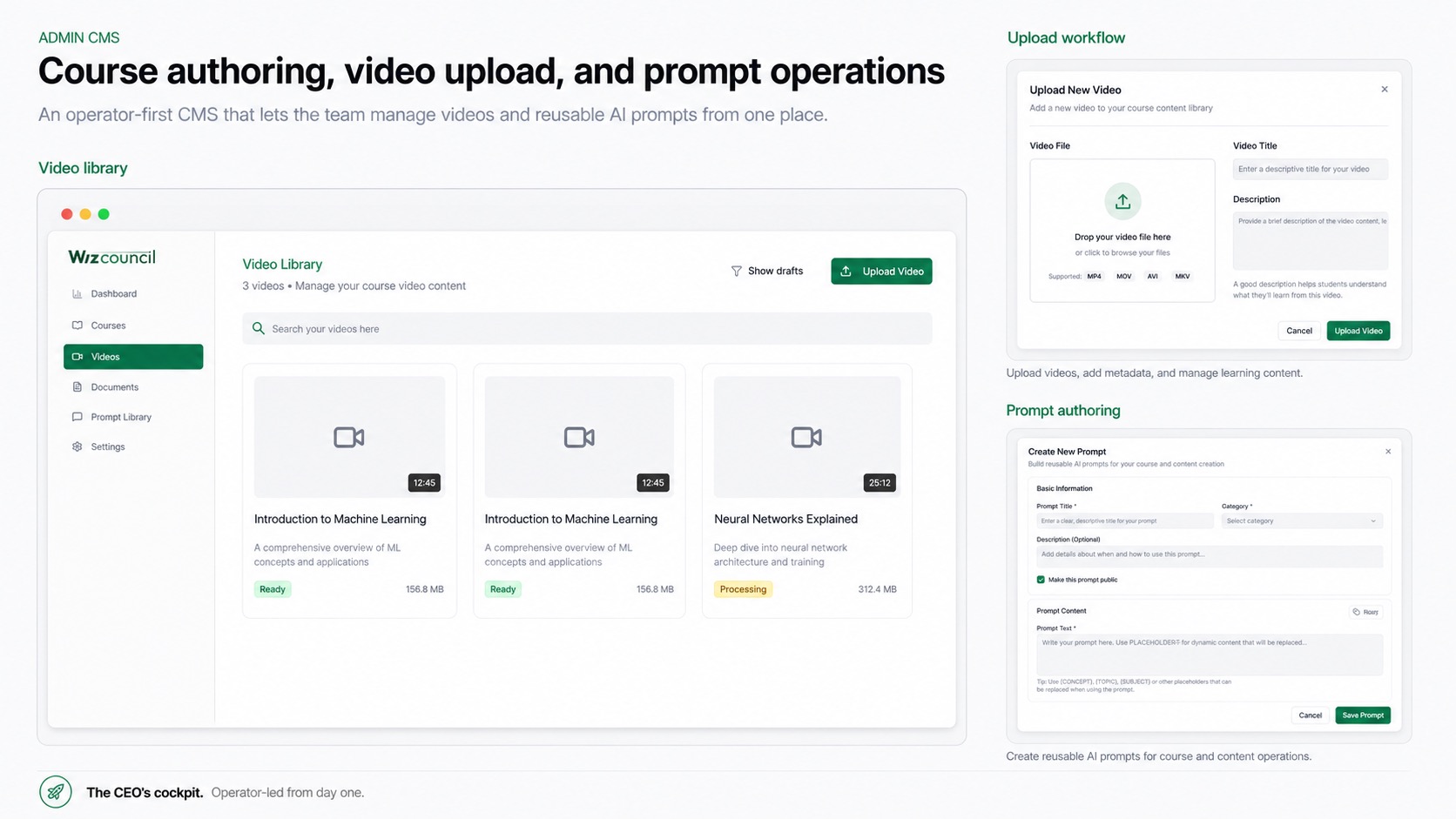
The hardest piece was building a CEO-controlled operating system for the entire platform. It supports video upload and auto-transcript flows, course/lesson/quiz authoring with reusable templates, prompt-library control, user and cohort management, payment configuration, and analytics.
- Course authoring, video upload, prompt operations, and quiz management.
- Designed so operational updates do not require engineering tickets.
- Now in maintenance: fixes and feature extensions can ship in hours through Claude Code.
Setbacks & saves
What almost went wrong
A legal notice killed the brand
The founder arrived with a brand — 'Sage of Growth', with its own logo, palette, and type. Mid-build, a legal notice landed: a major company claimed 'Sage'. The product build never stopped — I sat with the founder and rebuilt the identity in two days, swapped the site's copy and imagery, and the platform carried on under the new name: WizCouncil.
The membership pivot
Mid-build, the CEO switched the model from one-time course purchases to membership. Pricing, checkout, and the payment flows had to absorb the change in flight — and the website copy and design went through multiple rounds with it to keep the offer clear.
The payments maze
Payment aggregator rules, GST and tax compliance, and integration quirks ate more schedule than any design decision. The hardest skill on this build was estimation, not creativity — and I learned to scope compliance before committing dates.
A feature that expired mid-build
The prompt library was a real differentiator at kickoff. By launch, free prompt tools were everywhere and it no longer was. Lesson absorbed: feature relevance has a shelf life — re-validate it before the build finishes, not after.
Corporate landed after the build
The corporate offer arrived as a scope change after the product was already built. Instead of re-architecting auth and billing, we shipped the pragmatic version: a corporate path on the site, a bulk-onboarding flow — the company uploads its employees' email IDs, the dev team provisions access — and payments handled founder-direct with each company. Not every flow needs product machinery; some just need to work.
Act 03
What's left standing
shipped scope & lessons
The surfaces that shipped, and what the build taught me about working with non-technical founders.
3.1 Scope
What I built
Brand identity
Logo lockups, type system, palette, and motion principles.
Marketing website
Hero, problem section, testimonials, pricing, and two CTA paths.
Public learner product
Dashboard, course player, prompt library, checkout, and progress flow.
Admin CMS
Course authoring, video upload, quiz engine, analytics, and user operations.
Payments configuration UI
Stripe and Polar integration, tier management, and refund flows.
Corporate onboarding
Bulk employee onboarding for corporate clients — email-list upload, provisioned access, founder-direct billing.
3.2 Takeaways
What this project taught me.
Five things I'd carry into every zero-to-live engagement from here.
Write the hero line before touching layout.
I'd write the hero line before touching layout next time — 'Britain's Leading AI Institution' anchored every design decision that followed and I almost left it until the end.
Name the fear on day one.
The biggest unlock was naming the fear directly — not replacement, empowerment. I'd push for that research conversation on day one of every future engagement.
One brand system, two surfaces, documented early.
Keeping both surfaces inside one brand system from the start was the right call. I'd do it again but document the rules earlier so the admin side doesn't quietly drift from the public platform.
Build contingency into the engagement from week one.
When the legal conflict killed the original brand mid-build, treating the rebrand as a parallel workstream saved the timeline. I'd now build that kind of contingency buffer into every engagement from week one.
What I'd do differently.
I'd have run 3 real content-upload sessions with the team before finalising the admin CMS scope. We built the full course-creation and video-upload system assuming a certain workflow frequency — the tool was right, but the complexity level should have been stress-tested with actual use before committing to the full build.